When you travel to popularly known destinations, some questions usually arise: what other places might this destination be hiding? Could there be another site that surprises us during the trip? Coincidentally, concerns like these lead us to explore beyond what we already know, revealing the hidden secrets that many host destinations preserve, just like an ace up their sleeve that simply needs to be seized, enjoyed and, above all, experienced. Puno, like several Peruvian regions, is the cradle of many pre-Inca cultures that hold mysteries along the route, one of them being the Quechua route, a group of locations spread across two provinces of the region, Lampa and Ayaviri. Were you still unaware of these places? Let’s discover them!
The wonders of Lampa
Popularly known as the “pink city” or “the city of the 7 wonders”, it owes this name to its significant variety of historical attractions and buildings constructed in a distinctive pink colour, made from materials native to the area, both pink ashlar and a type of clay known as chocorosi. These materials can be found in various structures throughout the city, such as mansions ornamented with carved ashlar and rocks from Amantani Island. This whole group of buildings, including the Santiago Apóstol temple, transports visitors on a journey into the past, to the early years of the republican period. In the area there are also large forests of queñuales, Puya raimondii, tika tikas and other endemic plants that share the territory with a chinchilla breeding centre located 15 minutes on foot from the city centre.
1. The temple of Santiago Apóstol
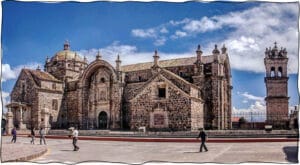 This temple is the greatest colonial jewel that the pink city possesses. It was built between 1675 and 1685, ordered by the Spanish bishop and archbishop of Cusco Manuel de Mollinedo y Angulo, almost entirely under the direction of the Arequipa priest Francisco de Goyzueta Maldonado. History mentions that, as a sign of the Spanish conquest or the New World, the seal of the Catholic cross was implanted, with which they sought to eradicate the Indigenous idolatries of that time. For this reason, the first to arrive in the Puno high plateau were the Dominicans, who were characterised by raising architectural structures that were not very sophisticated (humble), and later the Jesuits, who were known for building majestic architectural works. The architectural style in which the temple was built was Andean Baroque combined with several colonial Gothic elements and some Corinthian features, mostly using pink ashlar as the main material and the calicanto technique. Inside there is a copy of the statue of the Pietà, the ossuary, the catacombs, the art gallery and a wide variety of paintings from the Cusco school created by Isidoro Fernández Moncada.
2. The chinchilla breeding centre
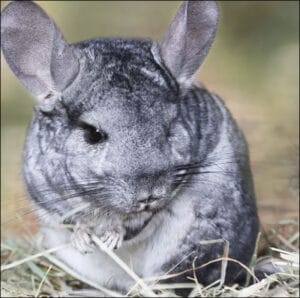 Located 15 minutes on foot from the centre of Lampa, this particular attraction was created thanks to the initiative of the philanthropist and engineer Enrique Torres Belón. According to history, around October 1964, news emerged of the existence of chinchilla breeding centres in California, United States, and that they were willing to sell some specimens to Peru. This quickly caught Enrique’s attention, as he remembered that some time before, Puno used to be populated by a large number of chinchillas which, unfortunately by then, had become an exterminated species due to indiscriminate hunting. Therefore, he thought it would be a great idea to repatriate some descendants of these animals. However, of course, this species in the Californian breeding centres was characterised by being domestic; they lacked contact with natural environments where their habitat usually is. Therefore, the idea of importing them with the intention of releasing them into their natural habitat was not a good idea, so it was decided to keep them in special cages. Enrique formed a commercial partnership for the breeding of these animals and, after several studies were carried out on where to locate the breeding centre, it was decided to place it in the area that we can visit today.
3. Kampaq Archaeological Museum
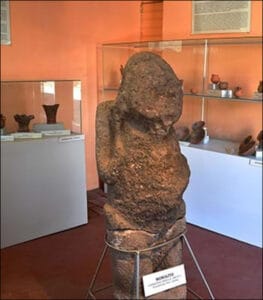 Located a few blocks from the centre of the city of Lampa, this museum was opened on 7 June 1987, promoted by Dr Jesus Abad Vargas Quispe, a graduate in social sciences, “history and geography”, from UNSAAC, who to this day continues to oversee the museum, continuing his work of more than 20 years collecting countless archaeological pieces from various cultures, not only from the Lampa area and some cultures of the country, but even including some remains from Central American Aztec culture, such as Cholula and Chupicuaro.
Among the numerous archaeological pieces displayed by the museum are items belonging to cultures that developed on the high plateau, such as the Collas, Lupacas and Tiahuanaco. On the other hand, the museum is also increasing its number of ceramics from coastal cultures such as Mochica, Chimú and Nazca. Within its wide repertoire, there are some remains of prehistoric animals such as the mastodon or the American horse, among many other historical relics.
4. Replica of the Pietà by Miguel Ángel Buonarroti
 It is known by many that one of the famous works of Miguel Ángel Buonarroti lies in the Vatican, but not many know that there are two copies of Miguel Ángel’s Pietà, which are the only ones in the world. These were made thanks once again to the initiative of Enrique Torres Belón, who, in an interest to beautify the crypt of the mausoleum inside the Santiago Apóstol temple, around the year 1960, requested a copy from the Vatican through a relative of his who had some closeness to the Vatican, as she served as a nun. At that time, it was headed by Pope John XXIII. This pope was known for not being very permissive, much less when it came to replicating such iconic works as the one found in St Peter’s Basilica, so it is unknown how he was convinced. What is certain is that he accepted the request and commissioned an identical copy of the original, made from plaster, to be sent to the colonial city of Lampa.
5. The Colonial Bridge
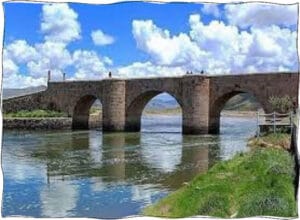 The Colonial Bridge of Lampa, located in the city of Lampa, dates back to 1846. The colonial bridge was built during the administration of the then deputy of Lampa, Enrique Torres Belón. It was built with worked stone and ashlar cladding, and consists of a walkway 4 metres wide by 77 metres long. It has 3 asymmetrical arches with two hexagonal support bases made of carved stone and lime. It is worth noting that the Lampa Bridge was declared Cultural Heritage of the Nation by the National Institute of Culture on 8 March 1991. And through Law No. 31203, a law was passed declaring the restoration, protection, conservation, enhancement and promotion of the Santiago Apóstol temple and the colonial bridge of Lampa to be of national interest and public necessity.
6. The Ossuary and the Catacombs
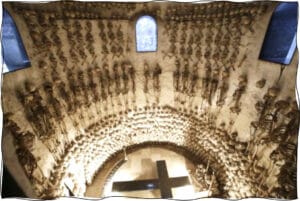 The ossuary holds many life stories and mysteries, and contains an impressive mausoleum that preserves in its base, walls and dome skulls and bones arranged with millimetric precision. The ossuary, which now appears to be a funerary work of art, was initially built with pink ashlar, but was restored in 1960 to then display its current appearance. It contains the remains of bishops, priests and more than a thousand important people from the area, such as Enrique Torres Belón, a notable mining engineer from Lampa who was deputy and senator for Puno. "Diario El Comercio. All rights reserved."
The catacombs are crossed by mysterious tunnels, supposedly Inca, which according to legend are said to lead to Cuzco or to gold mines, and those who entered them never came out again. What is certain is that in December 1780, Túpac Amaru, the great Peruvian rebel, arrived in Lampa on his triumphant march through Collao. In this church, some fearful refugees were celebrating mass; the Inca revolutionary ordered a priest to be beheaded at the altar. Later, he learned that there were Spaniards hiding in the tunnels and ordered his men to enter and kill them all.
7. Lenzora Cave
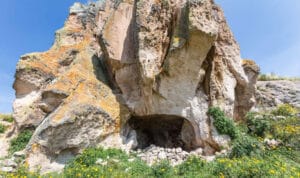 Lenzora Cave is located in Lampa and was declared Cultural Heritage of the Nation by the National Institute of Culture (INC) in 2003. At the site, you will find a group of rock shelters where cave paintings have been found, dating back 3,000 to 5,000 years, in which reddish pigmentation predominates. They are famous for the variety of cave engravings they contain. In addition, anthropomorphic beings can be observed, showing evidence of alpaca and guanaco hunting. The drawings are characterised by creating a sense of movement through curves and a fine image. Among its paintings, we can see foxes and felines, as well as masks with a magical-religious value, where it can even be seen that the animals show respect. Around 40 drawings were found at the site, among them 13 drawings with anthropomorphic themes, one mask, 27 camelids, as well as 25 vicuñas, two felines and 12 men.
The majestic rocky giants of Ayaviri
1. The jars
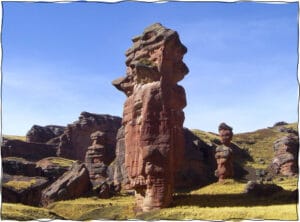 Scientific studies have revealed that, in ancient times, this place was the bottom of an immense lake and that its rock formations are the product of the work of water and wind. Some legends about this place tell that, many years ago, there was neither sun nor moon, and the canyon was inhabited by giant men who lived there. But the day the sun came out, the giants were completely petrified and turned into these enormous rock formations that we can now observe.
2. Myths of origin
The devil’s bath
According to the belief of some old Ayaviri residents, the devil uses the stone jars during the rainy season to bathe, causing a strange sound complemented by the sorrowful echo of many rock masses, which is why it is also known as the devil’s bath.
Rocky giants
Legend tells that in very remote times there was neither sun nor moon, and the inhabitants of these lands, whom they call “gentiles”, were as giant as, or even more giant than, these rocks. Some of them were their palaces, their hunting utensils, their women and children, but unfortunately for them, the sun (tayta inti) suddenly rose and petrified them, thus ending this generation of giants that populated the entire high plateau.
The Inca Pachacutec
One of them says that the Inca Pachacútec was thoughtful and worried, as he had learned that the Collasuyo region was suffering from drought, lack of food and the death of humans and animals. Faced with this, the Inca gathered the most prestigious fortune-tellers, who replied that the cause of the misfortune came from a devil that had taken possession of the region. The Inca, surprised by the answers and after consulting his priests, decided to put an end to these events. To do so, he ordered his army to make three stone jars in the Tinajani ravine. This was so that the devil would purify himself in the cold waters of these jars and then leave the region or remain imprisoned inside them.
3. The origin
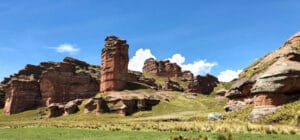 Regarding the origin of this imposing, strange and welcoming space, geologists state that these rock formations are sediments of reddish sandstone and that they were probably the bed of the great Lake Ballivián, predecessor of Lake Titicaca and Popo. Millions of years ago, this whole sector was covered with water. Then, after geological changes, it gradually dried up until it became what is now the famous navigable lake, “Titicaca”.
As a result, erosive agents such as wind, hail, snow and rain, which are very frequent in this area, have, “over the course of time”, sculpted these majestic rocks. Here, the hand of man did not intervene; perhaps for this nature, man is simply one more component, lost in some small natural hollows at the base of these stone masses.
The rocks, also known as the “Devil’s Canyon”, can reach tens of metres in height. The figures they form are left to the imagination of visitors, who will take away a pleasant surprise from this magnificent place.
Tinajani awaits you. Don’t just stay with the reading; live this and more stories with Puno Tours. Authentic, memorable experiences, ready for you.