
Have you ever felt the thrill of crossing paths with a wild animal in its natural habitat? Forget cages and zoos. On the plains of Puno, the adventure is real. Here, the landscape is the stage and the local wildlife is the star of a silent spectacle that few have the privilege of witnessing.
Prepare your camera and adjust your coat, because once in Puno, we take you to the heart of the High Plateau so you can get to know the stars of the heights up close. From herds of South American camelids at sunrise to migratory birds that paint the salt lagoons with colour. Keep reading to discover which species you cannot miss on your next expedition to Puno and how we can help you experience this encounter safely and sustainably.
What is the Puno High Plateau?
The Puno High Plateau is an inter-Andean plateau of tectonic origin, bounded by the Porco and Vilcanota mountain knots, extending between 3,700 and 4,800 metres above sea level. This high-mountain ecosystem has a cold, semi-arid climate, with average temperatures between 0°C and 7°C, a marked daily temperature variation —with minimums that can reach -25°C— and intense solar radiation as a result of lower atmospheric density. Its hydrography is structured by Lake Titicaca (3,914 m.a.s.l.), the highest navigable body of water on the planet, which acts as a microclimatic regulator and sustains a network of 25 tributaries distributed across four main basins: Ramis, Ilave, Coata and Desaguadero.
From an ecological perspective, the High Plateau is structured into two functional units: the puna, a high-Andean steppe dominated by ichu grasslands, tolares and queñuales, where the vegetation has developed physiological adaptations to withstand frost and drought; and the Titicaca lakeshore, a lacustrine strip with hydrophilic vegetation such as totora reed beds, rushes and bofedales, wetlands managed ancestrally to produce high-protein forage. This duality of environments forms the trophic base that allows the existence of specialised wildlife: camelids, aquatic birds and small mammals that not only survive at altitude, but have evolved to thrive in one of the most demanding environments on the continent.
Who are the protagonists?
South American Camelids
There are four species of South American camelids: llama, alpaca, vicuña and guanaco. Two of them are domesticated (llama and alpaca), while the other two live in the wild (vicuña and guanaco). All are perfectly adapted to the altitude and the extreme climate of the Andes.
1. Llama
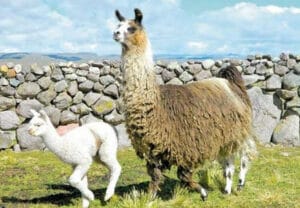 At first glance, the four Andean camelids may seem like very similar relatives, but each has its own story and personality. The llama is the largest and most robust of the group: it reaches up to 1.60 m in height and weighs around 200 kg. Its long, banana-shaped curved ears are its distinctive feature. Since pre-Hispanic times, it has been the “beast of burden” of the Andes, capable of carrying up to 25% of its weight along mountain trails. Its coat, thicker and less fine than that of its relatives, is used for rustic textiles, ropes and rugs.
2. Alpaca
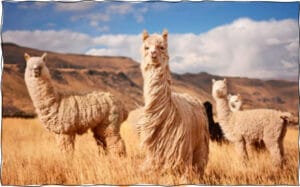 The alpaca, by contrast, is smaller —around 90 cm tall— and has a more delicate build. Its greatest treasure is its fibre: soft, warm and resistant, considered one of the best in the world for the textile industry. Unlike the llama, the alpaca is not used for carrying loads; its value lies in its wool, which can appear in more than 22 natural shades, from pure white to deep blacks and earthy browns. It is a fully domesticated animal, raised by high-Andean communities that depend on its meat, hide and, above all, its precious fibre.
3. Vicuña
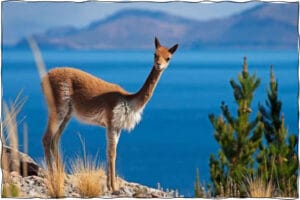 When we talk about vicuña and guanaco, we enter the world of wild camelids. The vicuña is the most slender and elegant: it measures between 75 and 95 cm, with golden fur on its back and a chest covered with white, silky tufts. Its fibre is the finest on the planet, so highly valued that for decades it was in danger of extinction due to illegal hunting. Today, thanks to conservation programmes and traditional ceremonial shearing, known as chaccu, its population is recovering.
4. Guanaco
 The guanaco, for its part, is larger and more robust than the vicuña, with reddish-brown fur on the upper part of its body, white on the belly and a dark face. It lives from the coast to the high mountains and, although it was never domesticated, its meat and leather have been used by local populations.
Keys to telling them apart
The key to telling them apart in the field goes beyond size: look at their ears (long and curved in the llama, pointed in the alpaca, small in the guanaco and vicuña), their behaviour (domesticated ones approach with curiosity; wild ones keep their distance) and their surroundings. While llamas and alpacas graze near communities and managed bofedales, vicuñas and guanacos prefer wilder and more protected areas. Knowing these differences not only enriches your observation, but also helps you value the conservation effort that keeps this emblematic wildlife of the High Plateau alive.
The Birds of Titicaca and the Puna
Birds of Titicaca and the Puna: A Winged Sanctuary in the Heights
The Titicaca National Reserve is a paradise for birdwatching lovers, home to more than 105 species that have developed unique adaptations to survive at more than 3,800 metres above sea level. From aquatic birds that navigate the waters of the lake to terrestrial species that inhabit the grasslands of the puna, each one tells a story of survival and beauty.
Emblematic Species of the Lake
1. Keñola or Titicaca grebe (Rollandia microptera)
 The most representative bird of the lake and a true endemic species. Brownish in colour, with a black head, white neck and reddish-brown body, it stands out for its yellow beak. It is unable to fly, but it is an exceptional diver that feeds on small fish, under 15 cm. Its presence is an indicator of the health of the lake ecosystem.
2. Great Grebe Duck (Oxyura ferruginea)
Endangered species
With a white neck and throat, black forehead and crown, and a distinctive straight, pointed blue beak, it is one of the largest diving ducks of Titicaca. Its feet, although they make it difficult to walk on land, work like perfect oars underwater. It is found in Chucuito, Juli, Ramis and Lake Arapa.
3. Puna Teal (Spatula puna)
Very common in the area, it inhabits lakes and rivers in Puno. Its black head, cream-coloured cheeks and blue beak make it unmistakable. It feeds on aquatic herbs and crustaceans, and is resident in both Peru and Bolivia.
4. Cinnamon Teal (Spatula cyanoptera)
Also known as the cinnamon-coloured teal, it has a small spoon-shaped beak, sky-blue wings with a white stripe and yellow legs. It feeds on seeds, plants, insects and aquatic molluscs.
Wetland and Shore Birds
1. Andean flamingo
The Andean flamingo or common flamingo (Phoenicoparrus andinus) is the pink “supermodel” of the puna, notable for being the only flamingo with yellow legs and an elegant black triangle on its back. It inhabits brackish lagoons between 2,000 and 4,500 metres above sea level, measures up to 1.36 metres in height and displays white-pink plumage. It feeds on algae and diatoms, which it filters through its black and yellow beak.
2. Great Egret (Ardea alba)
An impressive bird that reaches one metre in height, with completely white plumage, black legs and a black beak. It inhabits wetlands and is a spectacle to watch as it patiently fishes along the shores.
3. Black-crowned Night Heron (Nycticorax nycticorax)
Striking in appearance: intense red eyes, neck ranging from white to light grey, white face and belly, and black head, nape and back. Adults develop 2-3 long ornamental feathers. It feeds on fish, small reptiles and amphibians.
4. Andean Gull (Chroicocephalus serranus)
A resident of Titicaca, with a black head, which turns light grey outside the breeding season, white body, lead-coloured wings and a black tail tip. Its legs are dark red. It inhabits rivers, lakes, lagoons and marshes.
Terrestrial Birds of the Puna
1. Andean Flicker (Colaptes rupicola)
One of the few specialised terrestrial species. Its wings serve as camouflage in its surroundings; it has a dark grey head with red feathers on the nape, more noticeable in males, and a long beak that it uses to search for larvae in grasslands, pastures and riverbanks.
2. Golden-spotted Ground Dove (Metriopelia aymara)
Also called the golden-spotted little dove, it is golden-brown in colour with golden spots on the shoulders, a dark grey beak and red legs. Its tail and wing tips are black. It lives near homes and corrals, usually in groups or pairs.
3. Andean Swallow (Orochelidon andecola)
It inhabits mountainous areas and valleys. It has a black head with greenish highlights, a light grey throat, chest and belly, and dark wings and tail. It feeds on insects and is found in Peru, Bolivia, Chile and Argentina.
4. Peruvian Sierra Finch (Phrygilus punensis)
Known as the Andean sparrow, the male has a grey head and neck, yellow back and upper body, and grey wings. It feeds on seeds, insects and arachnids. It loves to sing and can be found among rocks, grasses, shrubs, ravines and queñoa forests.
5. Yellow-winged Blackbird (Agelasticus thilius)
It inhabits lakes, wetlands and dry fields. The male is predominantly black with a striking yellow colour on the wings, more visible in flight, while in the female the yellow is less visible. They always move around in pairs.
Small Inhabitants and Predators
1. Vizcacha (Lagidium viscacia):
This small rodent, belonging to the chinchilla family, has a compact body measuring 35 to 45 cm, covered in dense fur in grey and brown tones that allows it to blend into the rocky formations where it lives. During sunrise or sunset, its most active hours, it can be seen jumping agilely between the cracks in the hills, feeding on hard grasses, roots and lichens adapted to the harshness of the high-Andean climate. It is a social and cautious animal, lives in family colonies and emits high-pitched sounds to alert its group to any threat, a strategy that reflects its perfect adaptation to this ecosystem.
2. Wild guinea pig (Cavia tschudii):
It is a wild rodent that represents a fascinating evolutionary link with the domestic guinea pig we know from Peruvian gastronomy. This small mammal, 20 to 40 cm long and weighing approximately 320 g, is distinguished by its sparse greyish-brown fur, whitish belly, short ears and absence of a tail, adaptations that allow it to blend in among the rocky areas and vegetation of Puno’s valleys. Nocturnal in habit and social in small family groups, it feeds exclusively on grasses and fresh vegetables, playing a key role in the balance of puna ecosystems.
3. Andean fox (Lycalopex culpaeus):
It is a canid with dense fur in reddish and tawny tones that contrasts with its whitish belly, and a characteristic greyish tail with a black tip that can represent up to 50% of its body length. This opportunistic predator reaches between 4 and 13.8 kg in weight and up to 1.7 metres in length, including its elegant tail. Solitary and crepuscular in habit, although active both during the day and at night, the Andean fox plays a fundamental ecological role by regulating populations of rodents and lagomorphs, complementing its diet with birds, reptiles, carrion and even wild fruits, demonstrating remarkable adaptability to the high-Andean environment.
4. Andean puma (Puma concolor):
This majestic feline, known in Quechua as Puma and in Aymara as Titi, lives between 3,800 and 4,800 metres above sea level, moving stealthily among the bofedales of Azángaro, the hills of Lampa and the rocky areas of the Titicaca National Reserve. With short fur in tawny tones that blend with the ichu and tola vegetation, and powerful musculature that allows it to leap precisely over rugged terrain, the Puno puma reaches up to 1.8 metres in length and weighs between 50 and 100 kg, making it a key predator that regulates populations of vizcachas, Andean foxes and, occasionally, young camelids in the wild. Crepuscular in habit and elusive in nature, its presence is an indicator of ecological health in the puna, as it requires large expanses of well-preserved territory to survive.
5. Titicaca giant frog (Telmatobius culeus):
In the depths of Lake Titicaca, the highest navigable body of water in the world, located at 3,810 metres above sea level in the heart of the Puno High Plateau, lives an endemic amphibian that represents one of the most unique and threatened biological treasures on our planet. With its characteristic loose, folded skin that allows it to carry out gas exchange entirely through it, this frog can reach up to 50 cm in length and mainly inhabits muddy and rocky areas with submerged aquatic vegetation between 2 and 15 metres deep. However, this emblematic inhabitant of the lake, venerated by native peoples since pre-Hispanic times, faces an unprecedented crisis: classified as Critically Endangered in both Peru and Bolivia, its population has declined by more than 80% over the last three decades due to overexploitation for consumption in juices and medicinal preparations, lake pollution, the introduction of invasive species such as trout and silverside, and emerging diseases such as chytridiomycosis.
Would you like to meet the guardians of the puna? Experts or curious travellers, everyone is welcome. Book your tour and live the Andean experience you have always imagined.