Thinking about vast ancestral knowledge can take us through a great valley full of doubts and mysteries, but let us remember that the natural and the supernatural are closely linked. Although in our society we may see the supernatural as something extraordinary, remote, something separate from our lives, or we may even have completely dismissed this notion of the world, for many cultures like ours, the invisible is part of the visible. The cultures that emerged in the high plateau territory are no strangers to this whole mystical aura and natural or universal energies.
What is the Andean worldview?
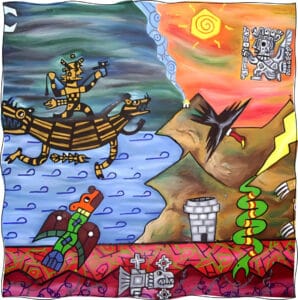 The worldview is a way of interpreting the world, what surrounds us, what we see. Developed over 5,000 years, the Andean worldview of the original Quechua peoples was formed from the civilisation of Caral through to the Incas and has survived to this day in the original Quechua communities.
The Andean worldview is a vision of caring for nature, the living cosmos (Pachamama) and the sacred relationship between human beings and the earth. It is also a vision of Andean communalism based on reciprocity (Ayni) and the care of human relationships, of living in community (Ayllu), of love and respect for living beings, children and elders, trees, mountains, rivers and the entire universe.
WAYS IN WHICH THE ANDEAN WORLDVIEW IS MANIFESTED
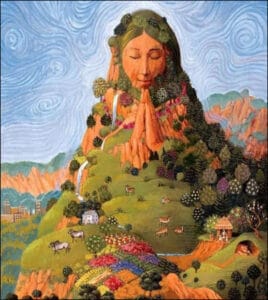 Pachamama: She is generally described as a female deity, responsible for promoting fertility in the fields, which is why in the Andean world she is the supreme deity of the mountains and high plateau areas. She is described as a very short Indigenous woman, large-headed and with big feet, wearing a wide-brimmed hat and huge ojotas. She lives in the hills and is often accompanied by a very fierce black dog. The snake is her lasso, and the quirquincho is her pig. Sometimes she carries leather trunks full of gold and silver. She is jealous, resentful and vengeful, but if someone wins her favour, she helps them. When she becomes angry, she sends thunder and storms.
Andean duality: This concept is understood as the opposition between two complementary essences; in other words, all opposites complement each other, which gives the Andean subject the only “space” in which they can live. Duality, Hanan and Urin (or hahua and ukhu), respectively, is based on the principle that everything transforms, because nature and space are not something still or immutable, but something in constant change, in continuous movement, something that renews and develops incessantly. In this sense, everything is connected; nature and space are an articulated and unique whole, in which objects and phenomena are organically linked to one another, depend on one another and condition one another.
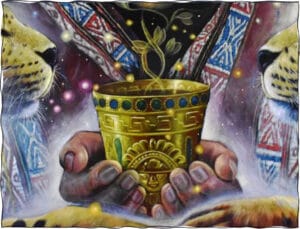 Spirituality in rituals: This is the ancestral Andean ritual of reciprocity and gratitude to Mother Earth for her sustenance, where coca leaves, chicha, corn, sweets and other symbolic elements are offered, buried or burned, and her blessing is requested for health, prosperity and good harvests, with 1 August being the main day of this ceremony.
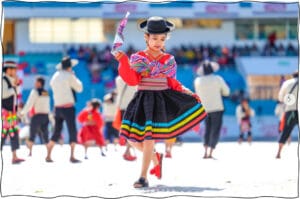 Dances: In general, Puno’s native dances are ritual and ancestral expressions that reflect the Andean worldview, characterised by their deep connection with agriculture, livestock farming and the veneration of deities such as Pachamama. These dances are performed with native music (sikus, pinquillos) and handmade wool garments, standing out for their energy, symbolism, bright colours and the use of elements such as feathers and mirrors.
THE MYSTERIOUS AYMARA BEING
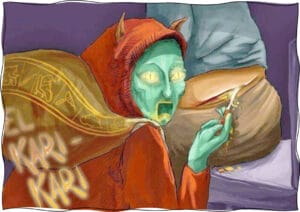 There is nothing that the Kharisiri cannot transform into. It can be a dog, a cat, a man or a baby. The Andean worldview says that this character made a pact with evil and obtained the powers of black magic. According to this myth from the Aymara Andean region, the Kharisiri are evil beings that act very stealthily. They put their victims to sleep and weaken them by taking their fat and blood, leaving them in agony.
According to the healers of the Andes, one must go to them so they can perform a ritual that reverses the evil.
LEGEND OF THE INTERDIMENSIONAL PORTAL OF ARAMU MURU
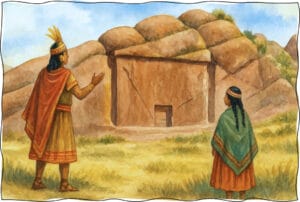 According to local oral tradition, during the time of the conquest, a high-ranking Inca priest called Aramu Muru fled with the golden Solar Disc, a sacred artefact that was kept in the Temple of the Sun in Cusco. Fearing that it would fall into Spanish hands, he travelled to Hayu Marca, where there was a portal carved into the rock.
There, accompanied by Andean priests, he performed a ritual in front of the portal. He placed the golden disc in a slot located in the centre of the doorway, which lit up intensely. At that moment, Aramu Muru disappeared by passing through the stone, according to witnesses. Since then, it is believed that the portal can be opened through special rituals and that it connects with other planes of existence.
The pacarinas: Ancient Peruvians believed that the first inhabitants of the ayllus, the Andean peoples, emerged from the pacarinas (caves, lakes, lagoons or springs) by order of the gods, especially Wiracocha. Before becoming human, they had been stones or rocks from the ukhu pacha (underworld), and through the pacarinas they came out to populate the kay pacha (earthly surface). It was a very sacred place for the ancient Peruvians, who worshipped it and left offerings there. This belief further strengthened their bond with the space where they lived and among the members of a community. These places were the subject of great pilgrimages that served to reaffirm that territorial, ethnic and spiritual bond with the pacarinas. They are mythical places of origin of the Andean peoples. These centres of creation are many, and the main ones were:
- The Cápac Toco cave (on Tamputoco hill): pacarina of the Inca ethnic group.
- The Choclococha lagoon: pacarina of the Chanca ethnic group.
- The Warivilca Spring: pacarina of the Huanca ethnic group.
- Lake Titicaca: pacarina of the Tiahuanaco ethnic group.
Activities that can be found on a mystical tour
- Ceremony of the Pagachi of the Coca Leaf, where the Andean shaman can communicate with the Apus through the ancestral leaf to begin the other rituals.
- Ceremony of the Challachi, where wine is used to sprinkle the holy earth, which will show us many geometric shapes that allow us to see our past, present and future.
- Ceremony of the Sahumerio, where the purification of our spirit is carried out, turning it into something new and pure.
- Ceremony of the calling of the Soul or Ánimo, where the physical body is united with the mind and spirit.
- The great ceremony of the “Apus” (Great Inca Spirits represented by the living sacred mountains).
Live the experience of a spiritual journey through the high plateau. At Puno Tours, we help you choose the best option for you. Do not hesitate to contact us!